

The first time I read a development's press material next to its search data, I thought I had been given the wrong file.
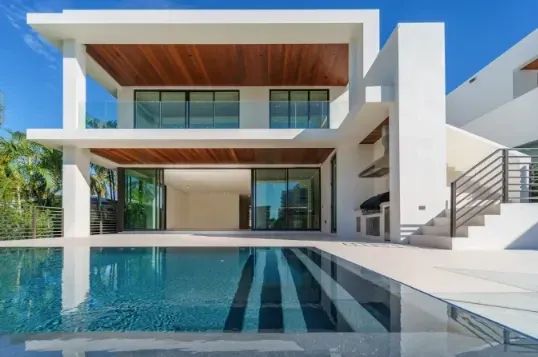
The brochure was beautiful. It spoke of a dialogue between the building and the palmeraie, the honesty of rammed earth, volumes organized around a central water axis. Every sentence was true. The architect had thought about it deeply and the result was genuinely good.
Then I looked at what people typed before they arrived on the site. Nobody had searched for any of it. Not one query contained the word volume. Not one contained axis.
What they searched was: gated villa near a school. Riad with parking. Property Marrakech foreigner can buy. Somewhere with a garden that a caretaker can manage when I am in Paris nine months of the year.
The Buyer Is Not Evaluating the Architecture First
This is the part that is hard to say in a room full of architects, so I will say it carefully. The design is why they buy. It is almost never why they arrive.
A cross-border buyer looking at a second home in Marrakech, Dubai or Jeddah is, at first, solving a logistics problem and a fear problem. Can I own this as a non-resident? How far is the airport? Who looks after it when I am away? What happens if I want to sell in six years? Is the neighborhood somewhere my family will actually use?
None of those questions are architectural. All are asked before the buyer has any interest in the material palette.
By the time someone is responsive to a description of rammed earth, they have crossed several thresholds you never saw. The brochure is doing work at stage five of a five-stage process, and the project has no presence at all in stages one through four.
I watched a palmeraie development spend eighteen months on extraordinary visual material and get almost no qualified inbound. What it lacked was a single page saying, plainly, whether a French buyer could hold the title, what the annual running cost was, and how long the drive from the airport really took.
Those three answers were sitting in the sales director's head. They had been said out loud on the phone hundreds of times. They existed nowhere a search engine or an AI assistant could see them.
What the Search Data Says About Property Discovery
The queries that produce serious inquiries for luxury property in Morocco are boring. That is the finding. They are almost embarrassingly boring compared with the way the projects describe themselves.
They cluster around ownership mechanics, location relative to a specific school or airport or district, whether a thing is legal for a foreigner, running cost, rental potential, and comparison against another city entirely. A buyer weighing Marrakech is frequently also weighing Dubai, and they will search that comparison in exactly those words.
The queries are increasingly not queries. They are full sentences asked to an assistant. Someone asks whether a European citizen can buy freehold in Morocco, and gets an answer assembled from whatever published material exists. If your material is a mood film and a paragraph about honest materials, it contributes nothing and the assistant reaches for whoever did write it down. Google has been explicit that generative results are assembled from published sources, which means the developer who wrote the boring page is the one being cited into the conversation.
There is a further layer that developers consistently underestimate. A very large share of the initial discovery is geographic in a literal sense. Buyers look at maps. They look at what is near what. The structured information that puts a property, an office or a project onto that map is a technical exercise, and the documentation for it is public. Most luxury developments have never done it, which is why a project worth tens of millions can be invisible next to a small agency that filled in its details properly.

The Translation Problem, Not a Dumbing-Down Problem
I am not saying the architectural language should be removed or simplified. It should not. It is the reason the project is worth what it is worth, and a buyer at this level can tell instantly when a development has no design conviction. What I am arguing is that a second body of language has to sit in front of it, doing the work of being found.
The brochure speaks to a buyer already in the room. Something else has to speak to the one nine months out, typing a nervous question into a phone at midnight.
The translation is usually straightforward once someone agrees to do it. A phrase about volumes organized around a central water axis becomes, elsewhere, a page explaining that the house stays cool in July without air conditioning running constantly, which is a running-cost answer and a comfort answer at the same time.
It is the same fact. One version wins an award. The other version gets found.
The architecture does not change. Only the door people walk through to reach it.
What Developments Should Actually Publish
The projects that work have, in my experience, written down the things the sales team already says on the phone.
The ownership mechanics for each nationality that actually buys there, written plainly, updated when the rules move.
The genuine annual cost of holding the property, including the parts nobody likes to publish.
The distances that matter, measured in the way buyers think about them, which is minutes in real traffic rather than kilometers.
What the surrounding district is like on a Tuesday in February, not in the launch film.
Who manages the property when the owner is absent, by name and by contract, because for a cross-border buyer this is frequently the deciding factor and almost nobody addresses it.
None of that is glamorous. All of it is what gets found, and it is what a serious buyer reads before they will let themselves fall in love with the images. Working alongside a real estate agency in Marrakech day to day, the pattern I see is consistent: the inquiries that convert almost always start from a plain question, and the design is what closes them at the end.
The buildings deserve better than to be found by accident. Most of them are.