
How Post-Occupancy Feedback Improves Future Building Design

What happens after a building opens can reveal more than plans and projections ever could. Feedback from occupants helps identify inefficient routes, daily frustrations, undersized offices, recurring complaints, and drainage risks. Insights from building design and operations experts show how these lessons can improve future projects.
The perspectives in this article were written by the named contributors and submitted through Connectively. Connectively's automated system selected them and used AI to write the headline, introduction, section headings, summary sections, and illustration, and to make minor edits for clarity. Articles are assembled and published automatically. Report errors to corrections@connectively.us. How we make our content
What the experts said
Respondent schedule / A-01 — A-05- A-01LB
 Walk Routes With OccupantsLilach Bullock
- A-02CT
 Track Daily Resident FrictionsCorina Tham
- A-03JH
 Size Offices for Current WorkJens Hagel
- A-04NK
 Turn Repeat Complaints Into DesignNick Kuang
- A-05BB
 Address Drainage Before InstallationBrad Baker
Walk Routes With Occupants
Lilach BullockAI Implementation Consultant and Fractional CMO · Lilach Bullock
Start by asking the people who use the space to show you where they work around it, because workarounds tell you more than a survey. I'm an occupant and operator rather than a designer. My first business moved from my kitchen table to offices with five staff, so I was the owner making the space work for the team. Using a wheelchair and then a walking stick changed how I judge any room. Once you've moved in, walk the route from the entrance to the toilets, the kitchen and the meeting room with the people who use the office, counting steps, measuring door widths and noting distances.
Track Daily Resident Frictions
Corina ThamSales, Marketing and Business Development Director · CheapForexVPS
1. In terms of honest feedback, it is rare that one would receive the most accurate from a survey. Typically, one would have to return to the development about 6 months to a year after and speak with the various residents. As a salesperson for real estate, I keep in contact with many of the buyers after they have moved into their respective properties and the casual conversations that take place at the lift lobby or over coffee and pastries at a restaurant provide the most accurate feedback. I also keep in close contact with property managers, security personnel and cleaners as they are the first to know of any problem that may arise with a development and how a development functions on a rainy Monday morning at 7am is totally different from viewing a showflat. Resale and rental agents are also a great source of information as units with similar layouts are constantly returned to the market or are renting faster than others.
2. One resident really liked her apartment but had a big problem with bringing home groceries. Although the drop-off point for deliveries was designed nicely, it was located a long way from the lift core and because it was not covered, residents were splashed on their way to the lift on afternoons with downpours. Although this may seem a trivial matter and I have mentioned it before, it affects how I view other developments and how I advise other developers and their buyers. In the end, buyers fall in love with a brochure but it is the small ways that you can make a buyer's daily life easier that keeps them as a loyal customer and gains them referrals to their friends and family. Those are the things that help build a good name for a developer in the long run.
Size Offices for Current Work
Jens HagelFounder & Owner · kjello
I'm not an architect, but as the owner of an IT firm in Hamburg I've been the client living in the building. After Covid our large office stood mostly empty. So when we moved in 2022 we picked 350 square metres with phone booths, standing desks and a balcony, and made it a meeting place that nobody is required to come to. The lesson I'd pass on is to size the space for how people work today. Jens Hagel, Founder & Owner, kjello (Hamburg, Germany)
Turn Repeat Complaints Into Design
Nick KuangCo-founder · Home Sweet Home Offers
The most honest design review happens months after move-in, when the people living in a space show you what they've stopped using. We renovate and resell houses across Northeast Ohio and also run short-, mid- and long-term rentals, so feedback comes from two directions. On rentals, I treat maintenance requests and guest reviews as a running record of how each space really works; when the same complaint shows up twice, it's a design problem, not a tenant problem. On flips, I check in with the buyer's agent after closing to ask what the buyers love and what they'd change. Guests kept mentioning that there was nowhere to drop coats, shoes and bags at the door, so on later renovations we started planning a simple entry drop zone with hooks and a bench before spending budget on decorative finishes. My takeaway: build a simple, repeatable way to hear from the people using the space, and treat small complaints that keep coming back as design input for the next project.
Address Drainage Before Installation
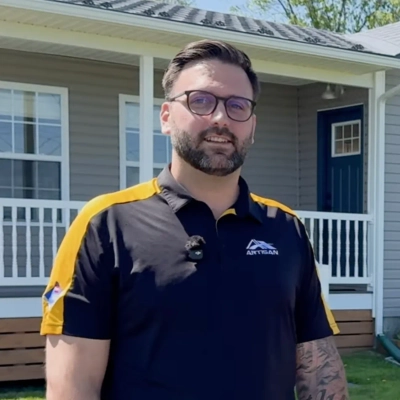
Brad BakerCEO · Artisan Roofing & Home Improvements Inc.
I don't see the job as being done simply because it's been completed and the customer is satisfied with how it looks. What counts is whether it performs its function once the homeowner starts making daily use of it. Having owned Artisan Roofing & Home Improvements since 2012, I have found out that one of the best sources of feedback for me is that which comes after the crew leaves.
I think that following up with customers and asking them easy questions is very important. For instance, is everything working just as expected? Do they see anything that they would want to change? Is there anything that they didn't find at the initial walkthrough?
A topic I always consider is that of water drainage. No matter how impressive the roof looks, if rainwater drains off in the wrong manner, the homeowner may end up having water accumulating around their foundation, walkways or doorways. These are some of the things which could easily be overlooked when all focus is on the actual roof installation.
This experience has made me consider my approaches during future roofing and home improvement processes. I consider the issue of water drainage during such projects and discuss this with the homeowner before we proceed with the process. Properties have different requirements, and this means that there cannot be a universal approach to this.
I also pay attention to the comments from the customers even if they are small grievances. We get most of our business from referrals, and this is possible only if the clients are satisfied with the quality of our work. Our reputation is based on the performance of the project after we leave, not on its performance on the completion date.
In my opinion, the best way to learn from a completed project is to hear what people who live with the results think. Such comments will help us fix small problems, improve our future projects, and save everybody's time. Good craftsmanship lies in paying attention to the details.